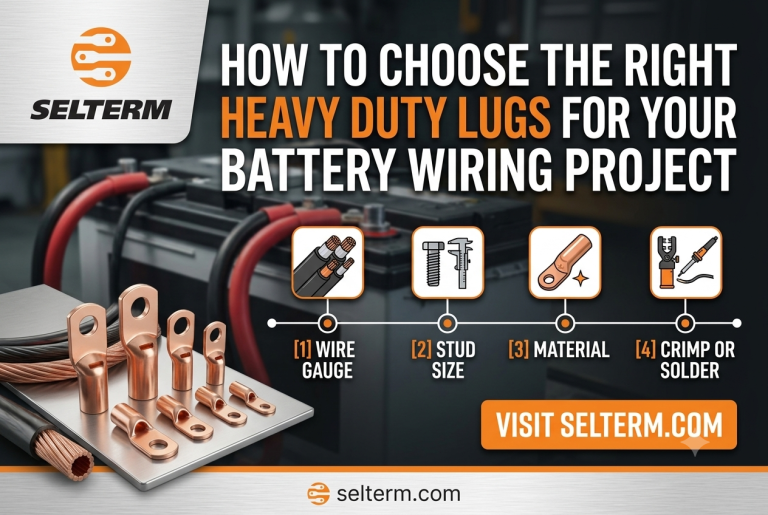
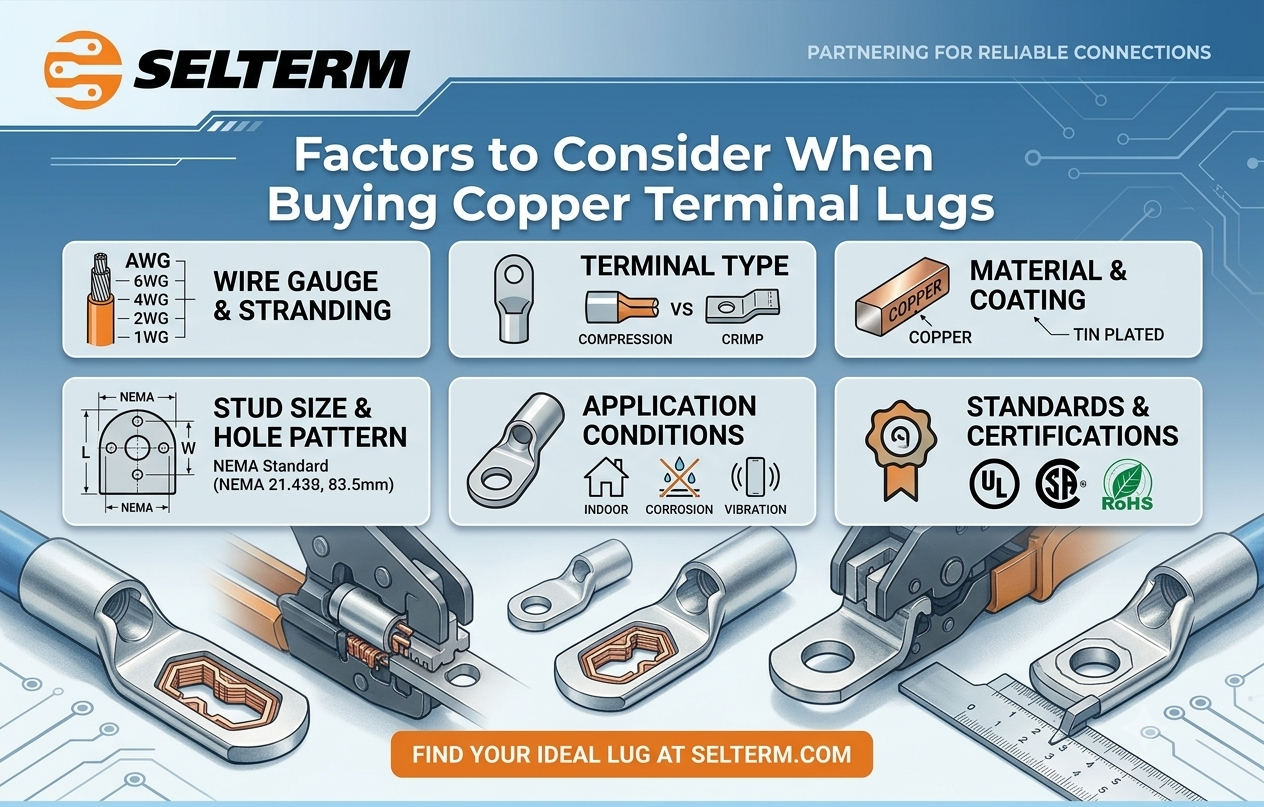
Grab the wrong lug once, and it’s a lesson that sticks. Whether it’s copper terminal lugs for a solar bank or battery terminal connectors for a truck rebuild, the difference between a good buy and a bad one usually isn’t visible until the crimp’s already done.
A few checks up front save a lot of trouble down the line, and most of them take less time than reading the packaging.
Bare vs Tinned: The First Real Decision
This is where most buying decisions should start, and where a lot of people skip straight past.
Bare copper terminal lugs conduct slightly better and cost less, making sense for dry, indoor, climate-controlled setups.
Tinned versions add a corrosion barrier that matters anywhere near salt air, bilge water, or road spray. Marine applications especially lean tinned for a reason, since bare copper oxidizes fast once moisture gets involved consistently.
Stud Hole Size Isn’t Universal
Assuming stud hole size based on gauge alone causes more mismatched orders than almost anything else.
Manufacturers vary slightly even within the same wire gauge, so checking actual measurements against existing hardware matters more than trusting a size chart blindly.
- Confirm stud diameter against the busbar or terminal block
- Check for metric versus standard thread differences
- Verify hole tolerance matches stud diameter closely
- Don’t assume all suppliers use identical sizing conventions
A five-minute measurement check avoids a return shipment later.
Barrel Diameter Needs to Match Strand Count
Two cables can share the same gauge number and still have noticeably different strand counts depending on manufacturer.
A barrel sized for one brand’s strand pattern might fit loose or tight on another brand’s version of the same gauge, which throws off crimp quality regardless of tooling used.
Battery terminal connectors especially vary here since flexible fine-strand cable and standard stranded cable pack differently inside the same nominal barrel size. Checking actual fit before committing to a full order prevents wasted material.
Wall Thickness Affects Durability
Thin-walled lugs cost less upfront but wear faster under repeated torque cycles or vibration exposure.
Heavier wall thickness holds up better on mobile applications where the connection experiences constant movement, road vibration, or engine heat cycling.
- Thicker barrel walls resist deformation under crimping pressure
- Cheap thin-wall lugs can crack at the stud hole over time
- Higher wall thickness typically correlates with better pull strength
- Marine and off-road applications benefit most from heavier construction
Saving a few cents per unit isn’t worth it on high-vibration installs.
Plating Consistency Across a Batch
Inconsistent plating on tinned copper terminal lugs shows up as patchy or uneven coating across a batch order.
That inconsistency usually points to a quality control gap somewhere in manufacturing, and it’s worth inspecting a sample before committing to a bulk purchase.
Seen it firsthand: A batch of tinned lugs arrived with visibly thinner coating on maybe one in ten pieces. Those started showing early corrosion signs within months, well before the rest of the batch showed any wear at all.
Crimping Compatibility Matters Before Purchase
Not every lug pairs cleanly with every crimping tool on the market.
Checking die compatibility before ordering saves the frustration of receiving lugs that don’t seat right in existing tooling.
Hex crimpers rated for a specific barrel diameter range need lugs that fall within that range, and mismatches here produce inconsistent crimps even with good technique. Confirming compatibility takes one phone call or spec sheet check.
Pull Strength Ratings Worth Checking
Reputable suppliers publish pull strength specs for their copper terminal lugs, and it’s worth comparing those numbers against industry minimums for the gauge in question.
Lugs without published pull strength data aren’t automatically bad, but it’s a detail worth asking about directly before a large order.
Batch testing a small sample before committing to full quantities catches quality issues before they become expensive across dozens or hundreds of connections.
Application-Specific Priorities
What matters most shifts depending on where the lug ends up.
- Marine builds prioritize tinned coating and corrosion resistance
- Solar installs prioritize consistent barrel sizing across large orders
- Truck and off-road applications prioritize wall thickness and vibration resistance
- Indoor industrial panels often prioritize cost with bare copper
Matching priorities to an application prevents overpaying for features that don’t matter or underbuying on ones that do.
Supplier Reliability Over Time
A single good batch doesn’t guarantee consistency on the next order.
Checking whether a supplier maintains consistent quality across multiple purchases matters more for ongoing projects than for one-off jobs.
Battery terminal connectors ordered in bulk for repeat production runs need that consistency, especially since variation between batches creates inspection headaches that eat into time savings from bulk ordering in the first place.
Bringing It Together
Buying copper terminal lugs well comes down to checking the details that don’t show up on a spec sheet headline.
Stud fit, barrel diameter, wall thickness, and plating consistency all matter more than price alone once a connection has to perform under real conditions.
Whether it’s battery terminal connectors for a mobile build or bulk copper terminal lugs for an industrial run, checking these factors before ordering prevents most of the comeback problems that show up later.
Buy smart, crimp once.
FAQ
1. What wire size and lug size do I need?
Match the lug’s barrel size to your cable’s American Wire Gauge (AWG) or metric rating, and ensure the stud/hole size matches the bolt or terminal post you are connecting to.
2. Should I choose tinned copper or bare copper lugs?
Tinned copper lugs are coated to resist corrosion and oxidation—making them ideal for marine, outdoor, or high-moisture environments—while bare copper lugs work well for dry, indoor electrical setups.
3. What is the difference between standard and heavy-duty lugs?
Heavy-duty lugs feature thicker walls for higher current capacity, better vibration resistance, and greater mechanical strength in demanding industrial or automotive applications.
4. How do I know whether to choose open-end or closed-end barrels?
Closed-end barrels seal out moisture and environmental elements to prevent internal wire corrosion, whereas open-end barrels allow quick visual checks to confirm full wire insertion.
5. How do I properly attach a copper terminal lug?
Strip the cable insulation to the specified length, insert the bare strands fully into the lug barrel, and compress it using a dedicated ratcheting or hydraulic crimping tool to ensure a solid, reliable mechanical and electrical bond.